A sprint retrospective becomes useful when the team leaves with a change it can try and a way to review what happened. Start with a specific observation, choose a problem you can influence, then ask someone to accept the next action. Agree when to inspect the result before ending the conversation.
You can use the action-and-review template in this guide to connect those decisions. It keeps the original issue beside the proposed change, owner and follow-up check, so the next retrospective can build on what the team learned.
Give the retrospective a useful outcome
A retrospective examines how the team worked. The Scrum Guide's Sprint Retrospective section describes inspecting the last Sprint and identifying helpful changes to quality and effectiveness. A product demonstration or list of completed work leaves a different question unanswered: what should the team change about its way of working?
Look at earlier actions before collecting new ones. Which were tried? What happened? If an action has no owner, clear scope or evidence to review, decide how to handle that gap. Carrying it into another meeting unchanged gives the team little to learn from.
For this walkthrough, the aim is to produce one manageable trial and its review record. Choose a scope the people involved can support; a long action list does not establish that anyone has capacity to do it.
Start with an observation you can inspect
Imagine a fictional delivery team discussing delayed reviews. Its illustrative event is simple: an item was ready for review, but no reviewer had accepted it. The board has no actual team quotes, work references, measurements or agreed decisions.
Your job as facilitator is to help the team examine what happened and agree a useful next step. Begin by asking for a permitted work reference and the relevant sequence. When was the item ready? How was review requested? Did someone accept it? When did review actually start?
Keep these events distinct. A request being sent does not establish that someone saw it or had capacity. Someone accepting a review does not establish that the review started immediately.
| Record | What it helps the team check |
|---|---|
| Observation | The event or pattern being discussed. |
| Evidence and limits | The reference, relevant times and what remains unknown. |
| Possible explanation | Something to investigate before treating it as the cause. |
A single event can expose a question, but it does not tell you how common the problem is. If the concern is repeated waiting, inspect the relevant items and agree which period and types of work you are discussing.
Make room for different accounts of the event. Someone may know that the item was missing an acceptance check; another person may know the intended reviewer was unavailable. Record those details without turning the discussion into a judgement about a colleague.
Choose an issue the team can influence
The observation gives you a starting point for possible explanations. In the example, the request might have been hard to see, reviewer availability might have been unclear, or the work might not have been ready to inspect. Those are questions to check.
Ask what supports each explanation and what would help distinguish it from the others. If nobody can reconstruct the handoff, the next action may be to gather that information before changing the process.
For the worked trial, focus on a handoff the team can influence: making the review request explicit and obtaining acceptance from an available reviewer. This would not create specialist capacity or resolve every reason a review waits. Check that the people and permissions needed for the trial are available.
Open the editable starter near the top of this page. It adds a fresh page alongside your existing drawings. Double-click a label to edit it. Replace the retrospective scope and observation first, then add possible explanations and the proposed change.
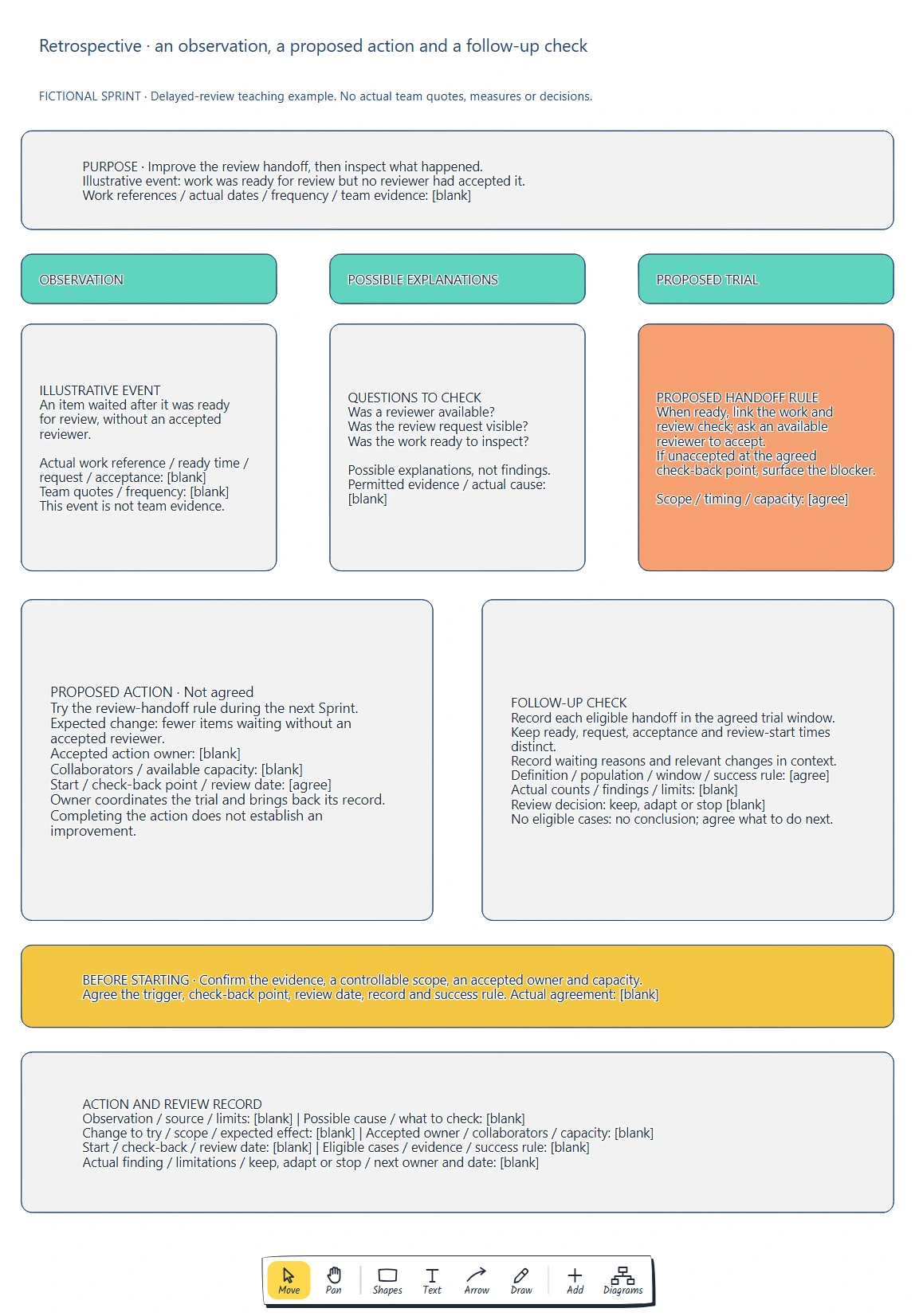
The board keeps the observation, explanations and proposed trial separate. Empty evidence and agreement fields show what the team still needs to establish.
Turn the idea into a bounded trial
“Improve reviews” leaves the action open to interpretation. Describe the behaviour someone can try, the circumstances in which it applies and what they should do when it cannot happen.
The example proposes this handoff rule: when an item is ready, link the work and review check, then ask an available reviewer to accept it. If it is still unaccepted at an agreed check-back point, surface the blocker.
Before trying it, agree what “ready” means for the included work. Decide where the request and acceptance will be recorded, and choose a check-back point that fits the team's working arrangements. The example does not supply a universal response-time target.
Keep the trial boundary visible. Which items are included? During which Sprint or dates? Who needs to participate? A small change to the handoff can be reviewed more clearly when the team knows where it applies.
Write the expected effect beside the action: fewer items waiting without an accepted reviewer. That is an expectation to examine, not an established result or a promise that all reviews will become faster.
Ask an owner to accept the follow-up
Atlassian's retrospective guidance recommends recording action items with owners and deadlines, and connecting them to the team's work tracking. Turn that into an explicit agreement with the people involved.
Ask a person to accept responsibility for coordinating the trial and bringing its record back. Name collaborators and check capacity with them too. The action owner does not become responsible for performing every review.
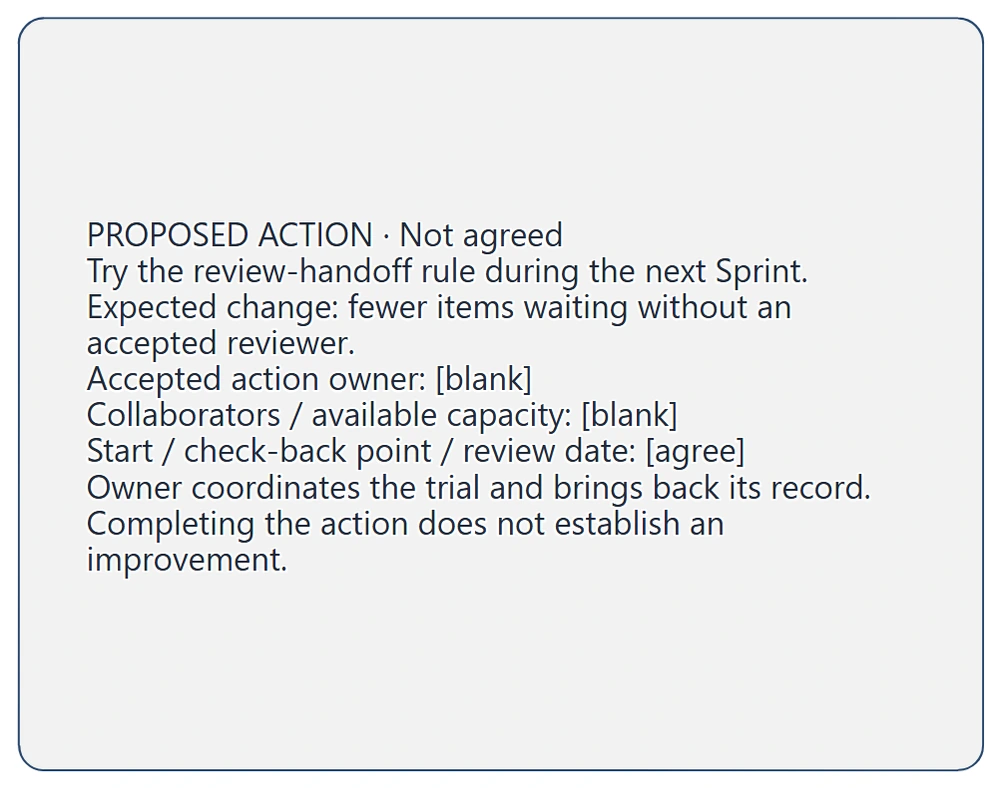
The action remains proposed until the owner, scope and timing are agreed. Its completion alone will not show whether the handoff improved.
Agree a start point, a check-back point for problems and a review date. “At the next retrospective” can name the occasion, but add the actual agreed date to the record. If a required participant cannot support the trial, narrow it or resolve that dependency before calling it agreed.
Put the accepted action where the team follows work between meetings. Link back to the retrospective record so someone can find the observation and reason behind it.
Use the product Kanban handoff guide to keep the accepted action, next check and any blocker visible between retrospectives.
Decide how you will tell whether it helped
Choose the follow-up check before starting. For this trial, record each eligible handoff during the agreed window. Keep ready, request, acceptance and review-start times separate, with any waiting reason and relevant change in context.
Agree the definitions and the sign of improvement you will look for. If you compare with earlier handoffs, check that their scope and recording method are comparable. The board leaves the population, window and success rule open for that agreement.
Review both whether the rule was used and what happened to the work. An item can have an accepted reviewer and still wait because of a different dependency. A shorter wait in a small trial does not by itself establish that the rule caused it.
If there were no eligible handoffs, you have no result to judge. Agree whether to extend the trial, change its scope or stop. Avoid closing the action as successful simply because nobody reported a problem.
Bring the findings into the next decision
Copy this sprint retrospective action items template:
Observation and permitted source:
Period, scope and limits:
Possible explanation and what to check:
Change to try and expected effect:
Eligible work and trial window:
Accepted owner, collaborators and capacity:
Start, check-back point and review date:
Evidence to record and success rule:
What was tried and what actually happened:
Limits, other changes and unresolved questions:
Decision: keep, adapt or stop:
Next action, accepted owner and date:
At the review, compare the record with the original observation and expected effect. Keep the change if the evidence and team experience support it. Adapt it when the boundary or behaviour needs work, or stop it when the cost or findings do not support continuing.
Record the reason and any next owner. That gives the following retrospective something more useful than the same unresolved action item.
Review checklist
- Is the observation distinct from a possible explanation?
- Is there evidence to inspect, with its limits visible?
- Can the team influence the proposed change?
- Has someone accepted the action, with collaborators and capacity checked?
- Are the scope, start, check-back point and review date agreed?
- Will the review examine the result as well as action completion?
- Is there a place to record a keep, adapt or stop decision?
Takeaways
Keep a retrospective action connected to the observation that prompted it. Define the change well enough to try, ask an owner to accept the follow-up and agree the review before starting.
Bring back what happened, including limits and unresolved questions. Use that record to decide what to keep or change next.
Optional: create the example with MCP
MCP lets a compatible assistant use EpicDraw's tools to create an editable planning board. You need a free EpicDraw account, cloud sync and an assistant supporting remote MCP with OAuth sign-in. Only cloud-synced pages are available remotely.
Follow the MCP connection guide, add https://epicdraw.app/mcp in your assistant and allow it to create and edit diagrams.
Use this prompt for the worked example:
Using the connected EpicDraw MCP server, create a new editable page named "Retrospective action and follow-up". Leave existing pages unchanged.

Create a board for a fictional Sprint with delayed reviews. Purpose: improve the review handoff and inspect what happened. Illustrative event: an item was ready for review but no reviewer had accepted it. Leave actual team quotes, work references, dates, frequency, measurements and agreed decisions blank.

Use three areas. Observation: the illustrative event, with actual work reference, ready time, request and acceptance blank. Possible explanations: was a reviewer available, was the request visible, was the work ready to inspect? Label these questions as possible explanations, not findings; leave evidence and actual cause blank. Proposed trial: when ready, link the work and review check and ask an available reviewer to accept; if unaccepted at an agreed check-back point, surface the blocker. Scope, timing and capacity need agreement.

Add an action record marked Proposed / Not agreed: try the handoff rule during the next Sprint. Expected change: fewer items waiting without an accepted reviewer. Accepted action owner and collaborators/capacity are blank. Start, check-back point and review date need agreement. The owner coordinates the trial and brings back its record. Completing the action does not establish an improvement.

Add a follow-up check: record every eligible handoff in the agreed window; keep ready, request, acceptance and review-start times distinct; record waiting reasons and relevant context changes. Leave definitions, population, window and success rule to agree, with actual counts, findings and limits blank. Leave the keep/adapt/stop decision blank. If there are no eligible cases, draw no conclusion and agree what to do next.

Add a before-starting reminder to confirm evidence, controllable scope, accepted owner, capacity, trigger, check-back point, review date, record and success rule. Add a blank reusable action-and-review record covering observation/source/limits, possible cause/check, change/scope/expected effect, accepted owner/collaborators/capacity, timing, eligible cases/evidence/success rule, actual finding/limits/decision and next owner/date.

Use editable shapes and text, label the scenario fictional and keep the proposal separate from agreement and evidence. Check overlaps and overflowing labels, then return a PNG preview and private editor link. Leave the result as a draft. Do not invent team evidence, obtain consent or claim the trial has run.
Inspect the PNG and open the private editor link while signed in. Assistant layouts vary, so check the distinction between observation and explanation, the proposed status, owner/date fields and follow-up check. Creating the board does not supply team evidence, obtain anyone's agreement or run the trial.
Keep your next draft close
Create a free account to save your pages in the cloud and use them across devices.
Create a free accountYou can keep drawing without an account.